

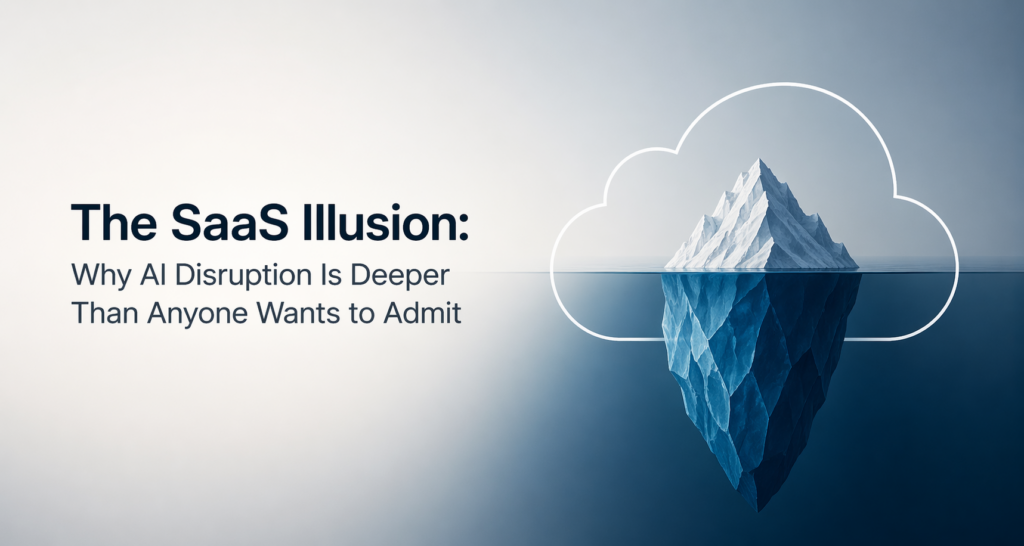
The SaaS Illusion: Why AI Disruption Is Deeper Than Anyone Wants to Admit
- Published:
1. Introduction to User Experience (UX)
Recently, I had a conversation that made my mind start bubbling. A stockbroker friend of mine confidently told me I should consider buying Salesforce stock. His reasoning was simple, almost comforting:
“The AI risk is already priced in. AI will reduce seat counts, but the market has already absorbed that.” On the surface, it sounds rational. Clean. Contained. But it’s also incomplete.
Because what’s coming for SaaS isn’t a single-variable adjustment like seat compression. It’s a structural rewrite. And if you’re responsible for product, experience, or growth inside your organization, this distinction matters more than any stock price.
The Easy Story: Fewer Seats, Lower Revenue
Let’s start with the part everyone agrees on. AI makes knowledge workers more efficient. Fewer support agents. Fewer analysts. Fewer coordinators. Maybe even fewer marketers. So yes—fewer seats. But here’s what often gets missed. Seat reduction isn’t the disruption.
It’s the first visible symptom. It’s the shallow cut that gets talked about in earnings calls because it’s easy to quantify. What’s harder to quantify, and far more consequential, is everything happening beneath it.
The Real Disruption - Four Layers Most People Aren’t Accounting For
If you pull back the curtain, AI is reshaping SaaS across multiple dimensions at once—not sequentially, but simultaneously.
- Roles Aren’t Just Shrinking—They’re Changing
The people who remain don’t work the same way. Support becomes exception handling.
Marketing becomes orchestration. Analysis becomes question design, not report generation. Which leads to a quiet but powerful shift: existing workflows hollow-out. And when workflows hollow-out, the tools designed to support them start to feel excessive.
Thirty screens become unnecessary. Twelve reports become noise. Feature-rich platforms begin to feel friction-heavy. This is where usage starts to decay—long before a customer ever churns.
- Features Are Losing Their Gravity
For years, SaaS growth followed a familiar playbook. More features → more value → higher price. AI flips that equation. Now:
- Summaries replace dashboards
- Natural language replaces filters
- Agents replace workflow builders
And suddenly, customers begin asking a dangerous question:
“What does this product do that an AI agent couldn’t approximate?”
This is what we call feature erosion. The product still exists. But its perceived value quietly weakens. And in a market where attention is already fragmented and expectations are rising, perception is everything.
- The Interface Is No Longer the Product
Historically, SaaS owned the experience. Users logged in. Navigated. Clicked. Configured. But in an AI-mediated world, the interface becomes optional. The real question shifts to:
Where does the decision-making live?
If an AI agent can operate across multiple systems, pulling data, making recommendations, even taking action, then the SaaS UI is no longer the center of gravity. It becomes one layer among many.
- The Control Plane Is Up for Grabs
This is the part that should make every SaaS executive pause. Because the future isn’t about which tool a human logs into. It’s about which system an AI is allowed to act within. That system—the one that governs data, permissions, trust, and action—is the new control plane.
And there are only three realistic outcomes:
- SaaS becomes the control plane (high value, defensible)
- SaaS becomes infrastructure (useful, but commoditized)
- SaaS gets bypassed entirely (replaceable)
Most companies are trying to move toward the first. Many will end up in the second. Some won’t realize they’re drifting into the third until it’s too late.
So What About Salesforce?
If they see this coming, they will shift their narrative from users to work. They will experiment with AI-driven pricing. They will lean into trust, data, and governance. But the real question isn’t whether they understand the shift. It’s whether they can become the place where AI is optimized to act. That’s not a feature roadmap problem. That’s a positioning problem. It is an identity problem.
Why This Matters Beyond SaaS
If you’re reading this from outside the SaaS world, it’s tempting to think this doesn’t apply to you. You’re wrong! It does.
Because this isn’t really about SaaS. It’s about a broader pattern:
- Interfaces losing importance
- Workflows collapsing
- Value shifting from execution to orchestration
- Decision-making moving closer to intelligent systems
We’re already seeing echoes of this in consumer products. Customers don’t just want products. They want outcomes, clarity, confidence. And when those aren’t delivered seamlessly, they churn—even if the product itself is objectively good.
The Quiet Risk Most Leaders Feel—but Struggle to Articulate
There’s a tension many leaders are carrying right now. On one hand, you’re expected to innovate. Move fast. Adopt AI. On the other, you can feel that something deeper is shifting. but are you able to explain it in a boardroom? It’s not just about tools. It’s not just about efficiency. It’s about how value is created, experienced, and trusted. And when those foundations shift, surface-level optimizations won’t be enough.
Where This Leaves You
If you’re responsible for product, experience, or growth, the question isn’t, “How do we add AI to what we’re already doing?” It’s, “If AI reshapes how people work, decide, and interact—what becomes unnecessary in our current model?”
And just as importantly, “Where does our real value live when everything else is stripped away?”
A Final Thought
My stockbroker friend wasn’t wrong. He was just looking at one layer of the system. But the leaders who will successfully navigate this space in time, are looking at the full picture. They’re asking harder questions. They’re mapping the complex second- and third-order effects. They’re thinking not just about disruption, but about reconstitution.
Because in the end, this isn’t about surviving AI. It’s about understanding where trust, meaning, and decision-making will live next, then deliberately positioning yourself there.
If you’re feeling the weight of that complexity, you’re not alone. Some of the most important work right now isn’t execution. It’s thinking clearly about what comes next. And having the right partners to help you think, plan and execute through it.
FAQs
AI is changing SaaS by reducing reliance on manual workflows, dashboards, and feature-heavy interfaces. Instead of navigating complex software manually, users increasingly expect AI systems to summarize information, automate tasks, and recommend actions directly. This shifts value away from software interfaces and toward intelligence, orchestration, and decision-making capabilities.
Feature erosion happens when AI reduces the perceived value of traditional software features. Tools that once required multiple dashboards, filters, reports, or workflows can now be partially replaced by AI-generated summaries, natural language queries, or automated agents. The software may still function, but users may no longer view all features as essential.
AI is reshaping how work gets done. Tasks that previously required multiple steps, screens, or employee roles can increasingly be automated or simplified through AI-driven systems. As workflows become more streamlined, businesses may reevaluate whether complex software platforms still match how teams actually work.
The control plane refers to the system responsible for managing data, permissions, trust, and automated actions across platforms. In an AI-driven environment, the most valuable systems may not be the ones employees log into directly, but the ones AI agents rely on to make decisions and take action securely.
This shift affects more than software companies. AI is changing how businesses deliver value, automate operations, support customers, and make decisions. Leaders across industries may need to rethink workflows, customer experiences, operational processes, and where their organization’s long-term value and differentiation truly exist.

Ready to Get Started?
Let’s create exceptional experiences together. Contact us today to discuss your project needs and discover how we can help you achieve your goals.

Through curiosity, collaboration, and integrity, we solve real-world challenges to create lasting value for businesses and the people they serve.
Contact Info
-
610 Freedom Dr
North Sioux City, SD 57049 - 605-232-4170